First 5 Pedal Essentials: Building Your Pro Pedalboard on a Budget
There is a specific moment in every guitarist’s journey when the “clean” sound of the amplifier is no longer enough. You want the atmospheric wash of your favorite indie tracks, the screaming sustain of a rock solo, or the percussive pulse of a lo-fi beat. This is where pedals come in. But in 2026, the market is flooded with thousands of options—how do you choose the first five that actually matter?
In this authoritative guide, we break down the “Foundational Five”. We’ll explain the signal chain logic (the order you plug them in), review the industry standards, and offer the best “hidden gem” budget alternatives for players who want a boutique sound on a bedroom budget.
Chapter 1: The Signal Chain Philosophy
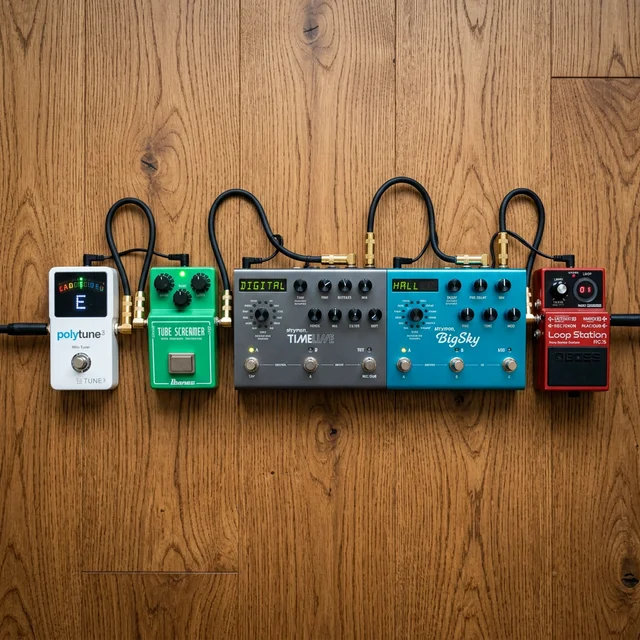
Pedals aren’t just a pile of boxes; they are an electronic ecosystem. The order matters because each pedal “processes” the sound of the one before it. – **The Standard Order**: Tuner -> Overdrive -> Delay -> Reverb -> Looper. – **The Logic**: You want your “dirt” (overdrive) to be clear, your “repeats” (delay) to bounce off that dirt, and your “space” (reverb) to wrap around everything at the end.
Chapter 2: The Foundational Five — Expert Reviews
1. The Tuner: The Most Important Pedal You’ll Ever Own
You can have a $5,000 vintage Gibson, but if it’s out of tune, it sounds amateur. A pedal tuner is more accurate than a clip-on and mutes your signal so you can tune silently on stage. – **Industry Standard**: **Boss TU-3**. It’s indestructible and used by 90% of pro touring musicians. – **Budget Hero**: **Donner DT-1**. It’s tiny, accurate, and costs less than a pack of strings.
2. Overdrive: The Heart of Your Tone
An overdrive pedal mimics the sound of a tube amp being pushed to its limit. It adds “warmth,” sustain, and grit. – **Industry Standard**: **Ibanez TS9 Tube Screamer**. It pushes the mid-frequencies, helping your guitar “cut through” the mix. Perfect for indie-rock and blues. – **Musician’s Insight**: If you want a more “open,” natural sound, look at the **Boss BD-2 Blues Driver**. It reacts to how hard you hit the strings, much like Mitski’s dynamic playing style.
3. Delay: Adding Dimension
Delay records your signal and plays it back a few milliseconds later, creating an echo. – **Industry Standard**: **MXR Carbon Copy**. This is an analog delay, meaning the repeats get “darker” and “lo-fi” as they fade, which sounds very natural. – **Budget Hero**: **Joyo Aqua**. It’s a dedicated analog-style delay that captures that vintage “wash” for under $40.
4. Reverb: The “Aura” of the Note
While many practice amps have built-in reverb, a dedicated pedal offers massive “Hall” and “Shimmer” sounds you can’t get elsewhere. – **Industry Standard**: **Boss RV-6**. It features a “Shimmer” mode that adds an ethereal octave above your notes—essential for modern Billie Eilish-style atmospheric tracks.
5. The Looper: Your Ultimate Practice Tool
A looper records a phrase and repeats it indefinitely. It’s not an “effect” as much as it is a “bandmate.” – **Industry Standard**: **TC Electronic Ditto**. It has one knob and one switch. It’s the easiest looper in the world to use. – **Why it matters**: Use it to record a rhythm part so you can practice scales or solos over the top. It is the fastest way to improve your lead playing.
Chapter 3: Powering Your Board (Avoiding the Hum)
One of the biggest mistakes beginners make is using cheap “daisy chain” power supplies. – **The Problem**: Cheap power sends electronic noise (hum) through your pedals. – **The Solution**: An **Isolated Power Supply**. Each pedal gets its own dedicated power source, ensuring a silent signal path. If you are on a budget, batteries are actually “purer” than cheap wall adapters, but they get expensive over time.
Chapter 4: The “Boutique” vs. “Budget” Myth
In 2026, the gap between a $200 pedal and a $40 pedal has shrunk significantly. Companies like **Donner**, **Nux**, and **Harley Benton** use the same digital chips found in high-end gear. – **Where to Splurge**: Spend your money on the **Overdrive** and **Reverb**. These are the “character” pedals. – **Where to Save**: You can safely buy budget **Tuners** and **Loopers**. They either work or they don’t; they don’t affect your “tone” the same way.
Final Verdict: The “Day 1” Pedalboard
If you have $150 to spend, here is the ultimate starter board:
- Donner DT-1 Tuner ($25)
- Boss BD-2 Blues Driver ($100 – Used)
- Joyo Aqua Delay ($35)
This simple chain will give you 80% of the tones found on modern radio. From here, you can add reverb and looping as you master your tab reading skills.
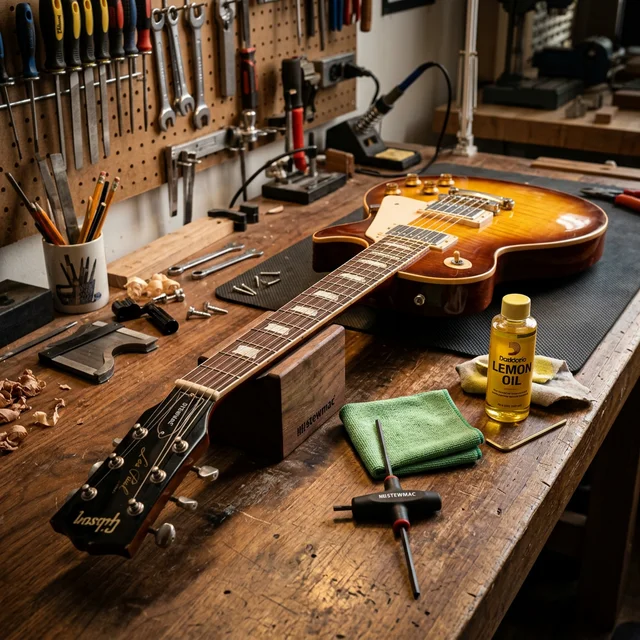
Ready to stomp? Make sure your guitar is set up perfectly first by following our Ultimate Maintenance Manual. A noisy pedalboard is much easier to fix than a buzzing neck!
GuitarVader is your source for authoritative gear reviews. When you buy pedals through our affiliate links, we earn a small commission which supports the site. Happy stomping!