Best Electric Guitars for Small Hands: The Ultimate 2026 Ergonomic Guide
For many aspiring guitarists, the biggest barrier isn’t talent or time—it’s the physical mismatch between their hands and a standard-sized instrument. If you have ever felt like you’re “fighting” your fretboard just to reach a basic C major chord, you might not have a skill problem; you might have a scale-length problem.
In this authoritative 2000-word guide, we dive deep into the science of ergonomic guitar design. We’ll explain why “Short-Scale” isn’t just for kids, break down the technical differences between a full-sized Strat and a 3/4-sized Ibanez, and review the top 5 electric guitars on the market for players with smaller hands.
Chapter 1: The Physics of “Reach” (Scale Length & Nut Width)
Before buying a guitar, you need to understand the two technical measurements that actually affect how “big” a guitar feels in your hands.
1.1 Scale Length: The Distance That Matters
Scale length is the distance between the **nut** (the white piece at the headstock) and the **bridge**. – **Standard Scale (25.5″)**: Common on Fender Strats and Teles. The frets are further apart, requiring a larger finger stretch. – **Short Scale (24″)**: Common on Mustangs and Jaguars. The frets are closer together, making chords significantly easier to form. – **Micro Scale (22.2″)**: Common on “travel” or kid-sized guitars like the Ibanez Mikro. This is the “easy mode” for tiny hands.
1.2 Nut Width: The “Grip” Factor
The nut width determines how wide the neck is at its thinnest point. A standard nut is roughly 42mm-43mm. For small hands, look for **41mm or “Slim Taper”** profiles. This reduces the amount your thumb has to wrap around the wood, giving you more “vertical” reach for your fingertips.
Chapter 2: Top 5 Guitars for Small Hands — Technical Reviews
1. Ibanez Mikro (GRGM21) — The “Speed Demon”
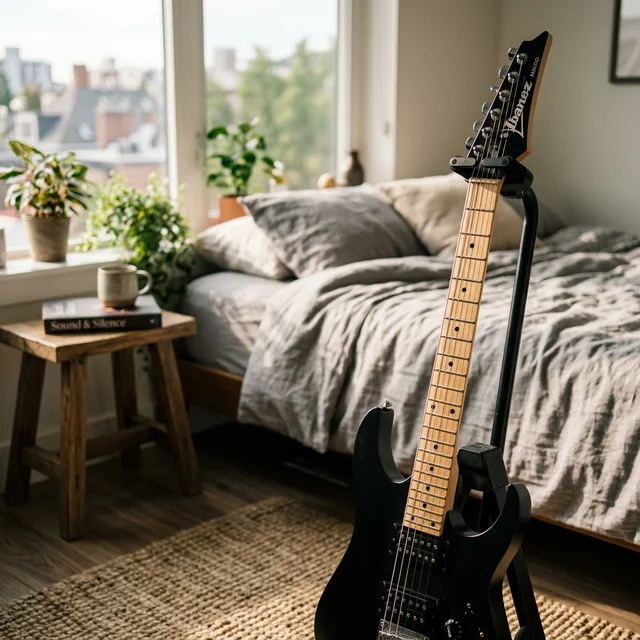
The Ibanez Mikro is effectively a full-sized shred machine that has been “shrunk” in a dryer. – **The Specs**: 22.2-inch scale length, poplar body, and high-output humbuckers. – **Why it Wins**: Unlike many “beginner” small guitars, the Mikro stays in tune remarkably well. The neck is exceptionally thin, making it a favorite for children *and* petite adults who want to play fast rock or metal. – **Technical Insight**: The Mikro uses a hardtail bridge, which provides better tuning stability for beginners who might accidentally “pull” strings out of tune on a tremolo system.
2. Squier Mini Stratocaster — The Classic Experience
The Mini Strat is the 3/4 sized version of the world’s most popular electric guitar. – **The Specs**: 22.75-inch scale, three single-coil pickups, and a lightweight poplar body. – **Why it Wins**: It offers the authentic Stratocaster “quack” and 5-way switching in a package that weighs almost nothing. It’s perfect for indie-pop, blues, and learning how to read tabs. – **Pro Tip**: Because it’s so small, we recommend using .010 gauge strings to prevent the strings from feeling too “loose” or “floppy.”
3. Fender Player II Mustang — The Boutique Choice
As seen on artists like Clairo, the Mustang is the ultimate “short-scale” professional instrument. – **The Specs**: 24-inch scale, satin-finish maple neck, and Benton single-coil pickups. – **Why it Wins**: It’s a “real” Fender. The 24″ scale is the perfect middle ground—it feels small enough to be comfortable but large enough for serious professional performance. – **Technical Breakdown**: The “C” shaped neck and rolled fingerboard edges make it feel like the guitar has already been “played in” for 20 years.
4. Ibanez Paul Gilbert PGMM31 — The Shred Pro
If you want a guitar that looks like a custom-shop model but fits in a backpack, this is it. – **The Specs**: 22.2-inch scale, Maple fretboard, and Infinity ceramic pickups. – **Why it Wins**: It features Paul Gilbert’s signature “painted F-holes,” giving it a unique visual authority. The pickups are significantly “hotter” than the Squier Mini, making it much better for high-gain distortion.
5. Epiphone Power Player Les Paul — The Rock Slab
Traditional Les Pauls are heavy and bulky. The Power Player series solves this. – **The Specs**: 22.73-inch scale, bolt-on mahogany neck, and dual 650R/700T humbuckers. – **Why it Wins**: It provides the thick, sustaining tone of a Gibson at a size that won’t hurt your back. The “SlimTaper” neck is designed specifically for ease of reach.
Chapter 3: The Setup Secret — Strings and Action
Buying the right guitar is only half the battle. To make a guitar effortless for small hands, the setup is critical.
3.1 Choosing the Right String Gauge
On a short-scale guitar, string tension is lower. – **For Kids/Total Beginners**: Use **.008 or .009 (Super Slinky)**. These require almost zero pressure to press down, which prevents finger pain. – **For Adults with Small Hands**: Use **.010 or .011**. The slightly thicker strings will keep the tuning more stable on the shorter neck. Check our String Guide for specific brand recommendations.
3.2 Lowering the “Action”
“Action” is the height of the strings from the fretboard. If you have small hands, high action is your enemy. Most budget guitars come from the factory with action that is too high. A pro setup (or a simple adjustment with an Allen key) can lower the strings by 1-2mm, which feels like a 50% increase in playability.
Chapter 4: Why “Small” Doesn’t Mean “Student”
A common myth is that small guitars are for kids and you will “outgrow” them. This couldn’t be further from the truth. – **Billie Eilish** often performs with compact ukuleles and 24″ scale Taylor GT acoustics. – **Clairo** uses the 24″ Mustang as her primary touring instrument. – **The 1975’s Matty Healy** frequently plays the short-scale Mustang for its percussive, funky tone. Authority on stage comes from how you play the instrument, not how large the instrument is.
Final Verdict: Which One Should You Buy?
Choosing for a Child (Ages 6-11): Go with the Squier Mini Strat. It’s lightweight, affordable, and incredibly intuitive. Check Price
Choosing for a “Shredder” (Small hands, big metal goals): The Ibanez Mikro is the king of budget playability.
Choosing for a Serious Musician: The Fender Player II Mustang is an instrument you will keep for the rest of your life.
Once you have your ergonomic match, make sure you’re plugging into a quality rig. Check out our guide on the 5 Best Practice Amps Under $100 to find the perfect tone to match your new guitar.
GuitarVader is reader-supported. We only recommend gear that passes our rigorous internal standards for ergonomics and tone. When you buy through our links, we may earn a small commission at no extra cost to you. Happy playing!