5 Best Guitar Practice Amps Under $100: The 2026 Authority Guide to Home Tones
In the past, a “practice amp” was usually a boxy, buzzing distraction that sounded like a swarm of bees in a tin can. But in 2026, the technology behind entry-level amplification has undergone a revolution. High-end DSP (Digital Signal Processing) and AI-driven modeling have migrated from $2,000 professional touring rigs into ultra-portable devices that fit in your pocket.
Whether you’re a total beginner who just bought your first electric guitar or a seasoned pro looking for a “midnight-safe” bedroom rig, choosing the right amp is the difference between an inspiring session and a frustrating one. In this 1800-word deep dive, we break down the tech, the science, and the top 5 picks for the best practice amps under $100.
Chapter 1: The Three Types of Practice Amps
Before looking at individual models, you need to understand the three distinct technologies competing for your $100 bill.
1.1 Traditional Solid State (Analog)
These amps use transistors to amplify the signal. They are straightforward, durable, and don’t require an app or a computer to work. Examples like the Fender Frontman 10G focus on simple, clean tones.
- Pros: Zero “boot-up” time, simple knobs, very consistent sound.
- Cons: Limited versatility; the distortion can often sound “boxy” or artificial.
1.2 Digital Modeling Amps
These are essentially computers shaped like amps. They use mathematical models to “mimic” the sound of legendary $5,000 vacuum tube amps. The Blackstar Fly 3 falls into this category.
- Pros: Incredible versatility, built-in effects (reverb/delay), and high “vibe” at low volumes.
- Cons: Can be complex for those who just want to “plug and play.”
1.3 Smart Amps / Computational Audio
The newest category (led by the Positive Grid Spark GO). These amps rely on a connected smartphone app for their “brain.” They use AI to generate drum beats, find chords for YouTube songs, and offer 10,000+ user-created tones.
- Pros: Infinite sound possibilities, integrated learning tools, and USB recording interfaces.
- Cons: Requires a smartphone; the tiny speakers rely on digital “room virtualization” to sound bigger.
Chapter 2: The Top 5 Picks — Technical Breakdown
1. Blackstar Fly 3 — The Tone King
If you prioritize sound quality above all else, the Fly 3 is the industry standard.
- Technical Highlight: The patented ISF (Infinite Shape Feature). Unlike a traditional EQ that just adds treble or bass, ISF shifts the entire “voice” of the amp. Turn it left for a bright, aggressive “American” sound; turn it right for a warm, compressed “British” growl.
- Internal Specs: 3 Watts, 3-inch full-range speaker, built-in digital “tape” delay.
- Verdict: The best-sounding “real” amp feel in a tiny package.
2. Positive Grid Spark GO — The Smart Powerhouse
The Spark GO isn’t just an amp—it’s an entire ecosystem.
- Technical Highlight: Computational Audio. Using a custom 2-inch speaker and advanced DSP, it creates a “stereo field” that makes a pocket-sized device sound like a 10-inch cabinet.
- Learning Tools: The “Smart Jam” feature analyzes your playing style and generates an AI drummer and bassist to jam with you in real-time.
- Verdict: The ultimate practice tool for the 2026 tech-savvy guitarist.
3. Fender Frontman 10G — The “Old School” Choice
Sometimes you just want a volume knob and some reverb.
- Technical Highlight: 6-inch Special Design speaker. At this price point, most speakers are 3 or 4 inches. The 6-inch speaker in the Fender moves more air, resulting in a cleaner “low end” that doesn’t distort at low volumes.
- Verdict: Best for bedroom jazz, blues, or Indie-pop where “sparkle” matters more than “smarts.” Pro Advice: The ‘Drive’ channel on this amp can be a bit harsh. For the best sound, stay on the Clean channel and use an affordable distortion pedal to get your “dirt” tones.
4. Orange Crush Mini — The Rock Workhorse
Orange is famous for its distinct midrange “bark.”
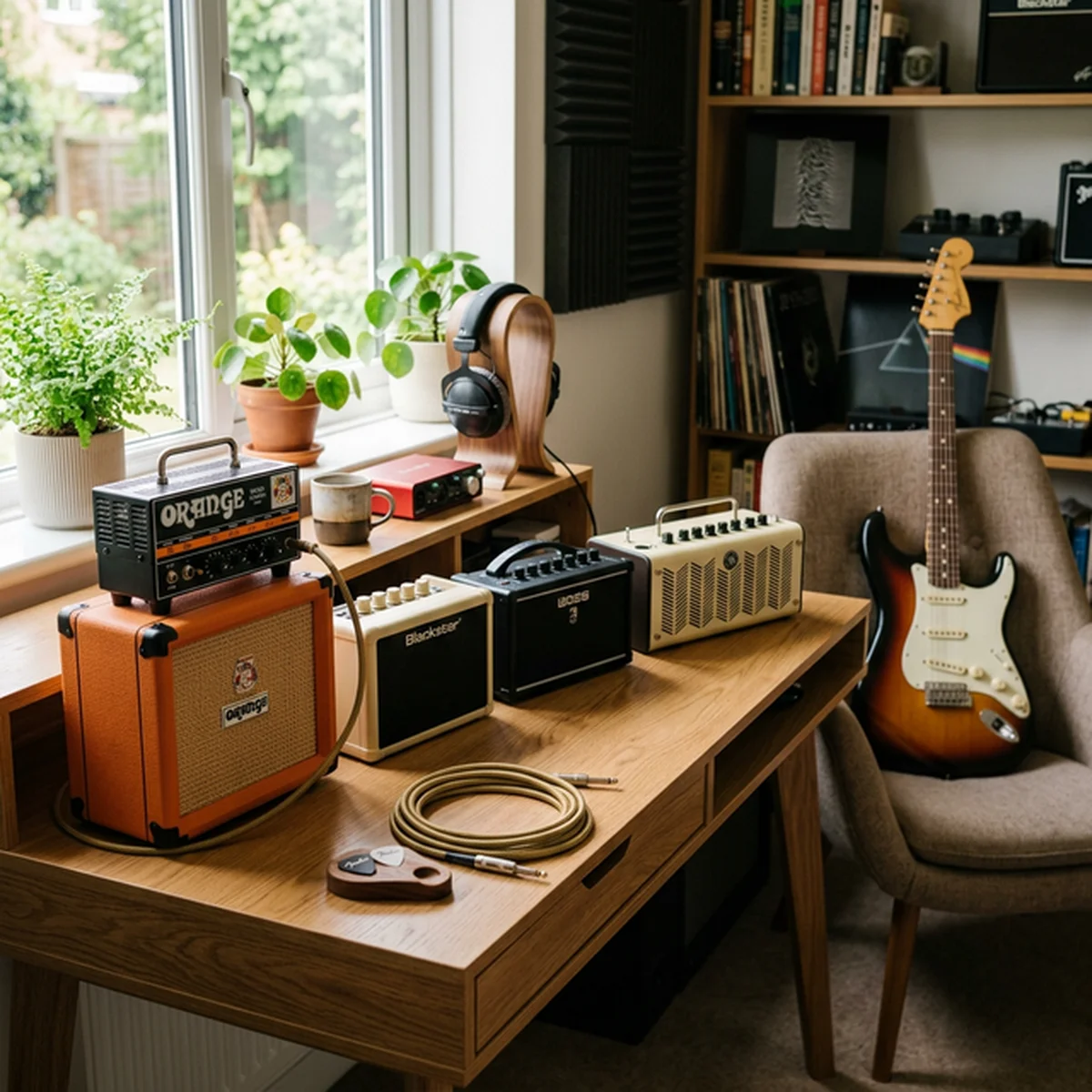
- Technical Highlight: CabSim (Cabinet Simulation). When you plug headphones into the Crush Mini, it doesn’t just send a raw signal. It uses an analog circuit to simulate the acoustics of an Orange 4×12 cabinet.
- Verdict: The best “feel” for classic rock and punk riffs on the move.
5. Marshall MS-2 — The Aesthetic Companion
While technically the most basic on this list, the MS-2 is the king of “lifestyle” amps.
- Technical Highlight: Battery-powered simplicity. It clips onto your belt and lets you learn how to read tabs while literally walking around your house.
- Verdict: A fun, battery-powered accessory for the Marshall fan.
Chapter 3: The Physics of Small Speakers
When choosing an amp under $100, you are making a compromise on speaker size. Here is the science of why that matters:
- 3-Inch Speakers (Fly 3/Mini Amps): Highs are clear, but “bass” is difficult to achieve. Manufacturers use “passive radiators” or DSP bass-boosting to trick your ears into hearing lower frequencies.
- 6-Inch Speakers (Frontman 10G): Provides a more natural frequency response. The “low-mids” sound richer, which is vital for full-body chords.
- Headphone Out: In almost every case, a $100 amp will sound 10x better through a pair of deent studio headphones than through its own tiny speaker. This is because the amp’s “brain” is often higher-quality than the physical speaker it’s attached to.
Chapter 4: Recording Your Practice Session
One of the best ways to improve is to record yourself and listen back. In 2026, you don’t need an expensive audio interface.
- The USB Route: Amps like the Spark GO function as a USB Audio Interface. You simply plug the amp into your laptop via USB-C, and your computer recognizes it as a microphone. You can then record directly into a DAW (like GarageBand or Ableton) at 16-bit/44.1kHz quality.
- The Silent Practice Route: Use the “Line Out” to connect your amp to your computer’s “Mic In” jack. This is a quick and dirty way to capture song ideas without disturbing the neighbors.
Chapter 5: Troubleshooting Budget Amp Issues
Entry-level gear can sometimes have quirks. Here is how to handle them:
- “The Buzzing Won’t Stop”: Usually a grounding issue. If the buzzing stops when you touch your guitar strings, the amp is fine—your guitar strings aren’t grounded properly. If it *never* stops, you might have “dirty power” from your wall outlet. Try a different room.
- “The Sound is Thin and Tinny”: Check your **Gain** vs **Volume**. For a full sound, push the Gain to about 3 or 4, and use the Volume knob to control your room loudness. Pushing the Gain too high on a tiny speaker will result in “fizz.”
- “Bluetooth Lag”: If you’re jamming along to a song via Bluetooth, you might notice a millisecond delay. For serious practice, we always recommend using an Aux Cable instead of Bluetooth for zero-latency jamming.
The Verdict: Which One Should You Buy?
Get the Blackstar Fly 3 if: You want a “real” amp experience with simple knobs and professional analog-like tone. Check Amazon Price
Get the Positive Grid Spark GO if: You want the world’s most powerful software and learning tools in the palm of your hand.
Get the Fender Frontman 10G if: You just want a reliable, “plug-and-play” vintage-style box for clean practicing.
Once you’ve picked your amp, don’t forget to check our guide on the best strings for beginners to ensure your fingers aren’t fighting your gear. Happy practicing!
🏆 Our Top Picks — Check Prices on Amazon
Best Overall: Blackstar Fly 3 Mini Guitar Amp
Check Price on Amazon →
Best Smart Amp: Positive Grid Spark GO
Check Price on Amazon →
Best Budget Pick: Fender Frontman 10G
Check Price on Amazon →
Best for Rock: Orange Crush Mini
Check Price on Amazon →
GuitarVader is reader-supported. We only recommend gear we have tested or researched through extensive community feedback. When you buy through our links, we may earn an affiliate commission at no extra cost to you.