The Ultimate Guitar Maintenance Manual: The 2026 Guide to Tech-Level Care
Most beginners treat their guitar like a piece of furniture—something that just “exists” in the room until it’s time to play. But a guitar is a precision instrument made of organic material (wood) that reacts to everything from the sweat on your hands to the humidity in your house. If your strings feel “stiff,” your neck is buzzing, or your tuning won’t stay stable, you don’t need a new guitar; you need a maintenance routine.
In this high-authority manual, we move past basic cleaning. We will teach you the technical skills usually reserved for professional guitar techs, including how to safely adjust your truss rod, how to deep-clean a fretboard, and how to “winter-proof” your instrument.
Chapter 1: The Daily & Weekly “Player’s Audit”
Authority starts with discipline. Pro players don’t wait for a guitar to break to fix it; they prevent the breakdown.
1.1 The “3-Second Wipe” Rule
Your sweat contains salt and acid that eats away at metal. After every session, use a dedicated microfiber cloth to wipe down the **bottom** of your strings. This simple act can triple the life of your strings and prevent the “gritty” feeling that makes sliding difficult. Check our String Guide for more on string lifespan.
1.2 The Hardware Check
Once a week, check your **input jack nut** and **tuner screws**. These are the most common “fail points” on budget guitars. Use a 10mm wrench to ensure the input jack is snug; if it’s loose, the wires inside will eventually snap, leading to a dead signal.
Chapter 2: Demystifying the Truss Rod (The Scary Part)
The truss rod is a metal beam inside your guitar neck that counteracts the 100+ lbs of tension from the strings. Many beginners are terrified of touching it, fearing they will “snap the neck.” In reality, it is a vital adjustment tool that you *must* learn to use.
2.1 When to Adjust
– **The “Banana” Test**: Hold your guitar like a rifle and look down the edge of the neck. Is it perfectly straight? Does it bow away from the strings (High Action)? Or does it bow toward the strings (Fret Buzz)? – **The Seasonal Shift**: Wood expands in summer (humidity) and shrinks in winter (dry air). You will likely need to adjust your truss rod twice a year.
2.2 How to Adjust Safely
1. Find the Allen key that came with your guitar. 2. **Righty-Tighty (Clockwise)**: Straightens the neck (lowers action). 3. **Lefty-Loosey (Counter-Clockwise)**: Adds bow (fixes fret buzz). 4. **The Golden Rule**: Only turn **1/4 of a circle** at a time. Let the wood settle for 10 minutes before checking again. If the rod feels “stuck” or requires extreme force, stop immediately and see a tech.
Chapter 3: Fretboard Science (Conditioning vs. Cleaning)
Not all fretboards are created equal. Using the wrong product can ruin your finish.
3.1 Rosewood, Ebony, and Pau Ferro (Unfinished Wood)
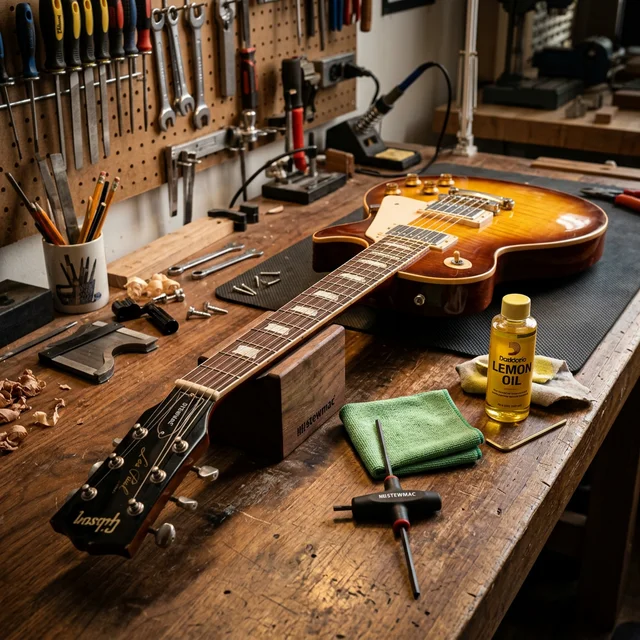
These woods are “open-pore” and can dry out, leading to cracks. – **The Solution**: Lemon Oil. Twice a year, apply a few drops to a cloth and rub it into the wood. Let it sit for 2 minutes, then buff it dry. This keeps the wood hydrated and darkens the look for a premium aesthetic.
3.2 Maple Fretboards (Lacquered)
Maple is usually finished with a hard clear-coat. – **The Solution**: **DO NOT use oil**. Oil cannot penetrate the lacquer and will just create a sticky mess. Simply use a damp (not dripping) cloth to wipe away dirt. If the lacquer is worn through, treat it like unfinished wood in those spots only.
Chapter 4: The Humidity War (Why Your Guitar is Dying)
In 2026, many homes have central AC or heating that makes the air extremely dry. – **The Danger**: Below 35% humidity, the wood on your guitar will shrink. This causes “Fret Sprout” (sharp fret ends) and, in acoustic guitars, can lead to devastating body cracks. – **The Fix**: Buy a $10 digital hygrometer. If your room is consistently dry, keep your guitar in its case with a **case humidifier**. It’s the cheapest insurance policy you’ll ever buy.
Chapter 5: Tech Tip — Nut Lubrication
If you tune your guitar and it makes a “ping” sound, your strings are getting stuck in the nut slots. – **Musician’s Insight**: You don’t need expensive “nut sauce.” A standard #2 pencil (graphite) rubbed into the slots during a string change will act as a dry lubricant, drastically improving your tuning stability during bends.
Final Verdict: The Maintenance Starter Kit
Every home tech needs these five things:
- Quality Microfiber Cloths (Keep one for strings, one for body).
- Lemon Oil (For rosewood/ebony boards).
- Digital Tuner (Precise tuning is the first step to checking neck relief).
- String Winder/Cutter (Makes string changes a 5-minute job).
- String Action Gauge (A small metal ruler to measure your string height exactly).
A well-maintained guitar is a guitar you will want to play every day. Now that your instrument is in top shape, check out our guide on the Best Guitars for Small Hands if you find your current neck profile still feels wrong for your frame.
GuitarVader provides expert-level technical advice for the modern player. When you buy maintenance gear through our links, we earn a small commission at no extra cost to you. Keep it clean, keep it in tune!